DataBETA = Database for Epigenetic Evaluation of Treatments for Aging
We are compiling an open database — free to all researchers — correlating anti-aging results with anti-aging interventions. The interventions are logged through a detailed questionnaire about every aspect of personal anti-aging activity. The evaluation is via methylation clocks — the best currently available measure for the rate of biological aging.
Watch our Introduction 3-min Video for prospective participants and others who want a quick introduction to the DataBETA project.
We’ve been testing different supplements, trying different diets and exercise programs.
We’ve been guessing what works, based on animal tests and a bit of biochemistry. We’ve had to guess because we have no human data. Lifespan trials in humans take decades and cost hundreds of millions of dollars.
That’s what has changed. There is now a blood test based on DNA methylation* that measures biological age, predicting vulnerability to age-related disease even better than a person’s actual, chronological age. It works well enough that we should be able to measure the benefits of an anti-aging program over a period of one year.
For the first time, we can test multiple supplements simultaneously. This is important, because much of what we do is redundant. Many diet regimes and supplements work on a few biochemical pathways. The pathways become saturated, and the result is that we’re adding the same three years to our life expectancy over and over again.
Synergy is when two different supplements combine to produce a bigger benefit than the sum of their separate effects. Synergy is what we’re looking for. It is the exception to the rule, which is redundancy. The DataBETA program is designed to find the rare combinations that work together to produce a big anti-aging benefit.
* Methylation = chemical markers that the cell hangs on the DNA to signal which genes are turned on and which are turned off. It is clear that methylation is currently the best measure of biological age, and some researchers believe that epigenetic expression, as typified by methylation, is at the root of age-related degeneration.
We are recruiting 5,000 participants—people who are doing things to extend life expectancy that most people don’t know about or would not consider. We offer them an extensive questionnaire about everything from social conditions to prescription drugs, and follow up to see which answers change over time. Each person receives a methylation test at the beginning and end of a one-year period.
At the end of the the year, we will make a plot of how much people aged over that time. We expect to see a bell-shaped curve, with most people aging two years, or perhaps a little less if the things we are doing are generally effective.
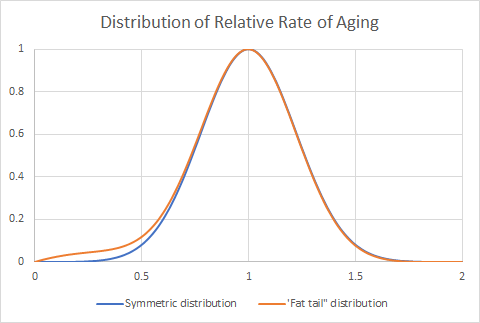
It is the tail ends of that bell curve that has the most information. We will look for a “fat tail” in the bell curve, consisting of an excess of people at the end that suggests very slow aging. We will use data mining and multivariate analysis to find combinations of factors that may account for the especially slow aging achieved by people in this group. If we find factors that are common to this group, then we will have a good candidate for a combination of treatments that is very effective at slowing the aging process. These combinations—if found—will be good candidates for a placebo-controlled trial in the future.
All data will be in the public domain, so that other researchers can pursue other statistical strategies.
More details about the program and the data analysis plan have been published as a peer-reviewed academic article in Rejuvenation Research and in a special aging issue of Biochemistry.
We are looking at patented and unpatented drugs, supplements, diets, fasting schedules, exercise, and life-style interventions without a preconceived template.
Section with image on the right
We don’t know what we will find. As Einstein said, “If we knew what we were doing, it wouldn’t be research.”
It is our hope to find combinations of interventions that appear to promising to slow the pace of aging or even reverse biological age.
If we are very fortunate, we will find evidence that stands on its own to validate some particular interventions.
The existence of a reliable measure of biological aging means that we can evaluate what we are doing without testing a large population and waiting for some of them to die.
The first credible and accurate test for biological age is the methylation clock. Ten years on, There are now dozens of clock algorithms based on methylation, and they are changing the landscape of longevity research.
Methylation clocks were first developed by UCLA professor Steve Horvath. “Methylation” refers to chemical markers on DNA which contributes to control of which genes are turned on and off. Many factors go into the control of gene expression, and age is one of them.
Dr. Horvath’s pioneering study looked for places in human DNA where methylation was most closely correlated with age. Computer optimization then produced an algorithm for combining information from these sites that accurately predicts age.
Subsequent generations of methylation clock by Horvath and others are calibrated not just by chronological age, but also with measures of health and, using historic blood banks, with actual mortality data. So far, some of our favorite clocks are the PhenoAge clock, the Dunedin Pace clock, and the Levine PCA clocks.
DataBETA will use methylation clocks to evaluate the rate of aging in a brief one-year window. Participants will receive an at home-blood, convenient and painless blood sample kit from TruDiagnostic. Tru will evaluate the blood sample using methods and equipment from Illumina Corp to calculate each subject’s methylation age at the beginning and end of our year-long trial.
DataBETA is entirely open-source. All information will be anonymized and shared with the public. Raw data will be available for any researcher to analyze, except that names and identities of individual participants will remain private. Josh Mitteldorf, PhD is our in-house scientific director, and he will do a first-pass analysis of the data. But we expect that other researchers with different ideas and different fields of expertise will find patterns beyond what our analysis reveals.
Our scientific director and study author is Josh Mitteldorf, a polymath who has contributed both original research and popular articles about aging for over 25 years. His book, Cracking the Aging Code, articulates a ground-breaking theory about the relationship of aging to evolutionary ecology. Our project director is Dr. Ashish Rajput, PhD. Other staff members include Walter Crompton, Bill Hees, and Tamar Valdman. [Link to CVs or home pages of other project members - Member pictures would look good here.]